- By Admin
- Corporate
The Use of Swivel Casters to Enhance Mobility
In modern workshops, factories, and congested warehouses, space is often limited, leaving little room for extensive maneuvering. Aisles flanked by assembly lines or high shelving units create complex logistical challenges that demand immediate responsiveness and sharp changes in direction—all without requiring strenuous physical effort or wasting valuable time. Relying solely on linear movement mechanisms makes navigating around obstacles both exhausting and risky; collisions can lead to significant damage to transported goods and rapid wear and tear on the facility’s internal flooring or pathways.
Full control over the movement of equipment and transport carts is a critical factor in boosting daily productivity. If your goal is to accelerate workflows and streamline the movement of products, adopting flexible steering solutions is essential for overcoming spatial constraints.
What is a swivel caster, and what is its primary operational advantage?
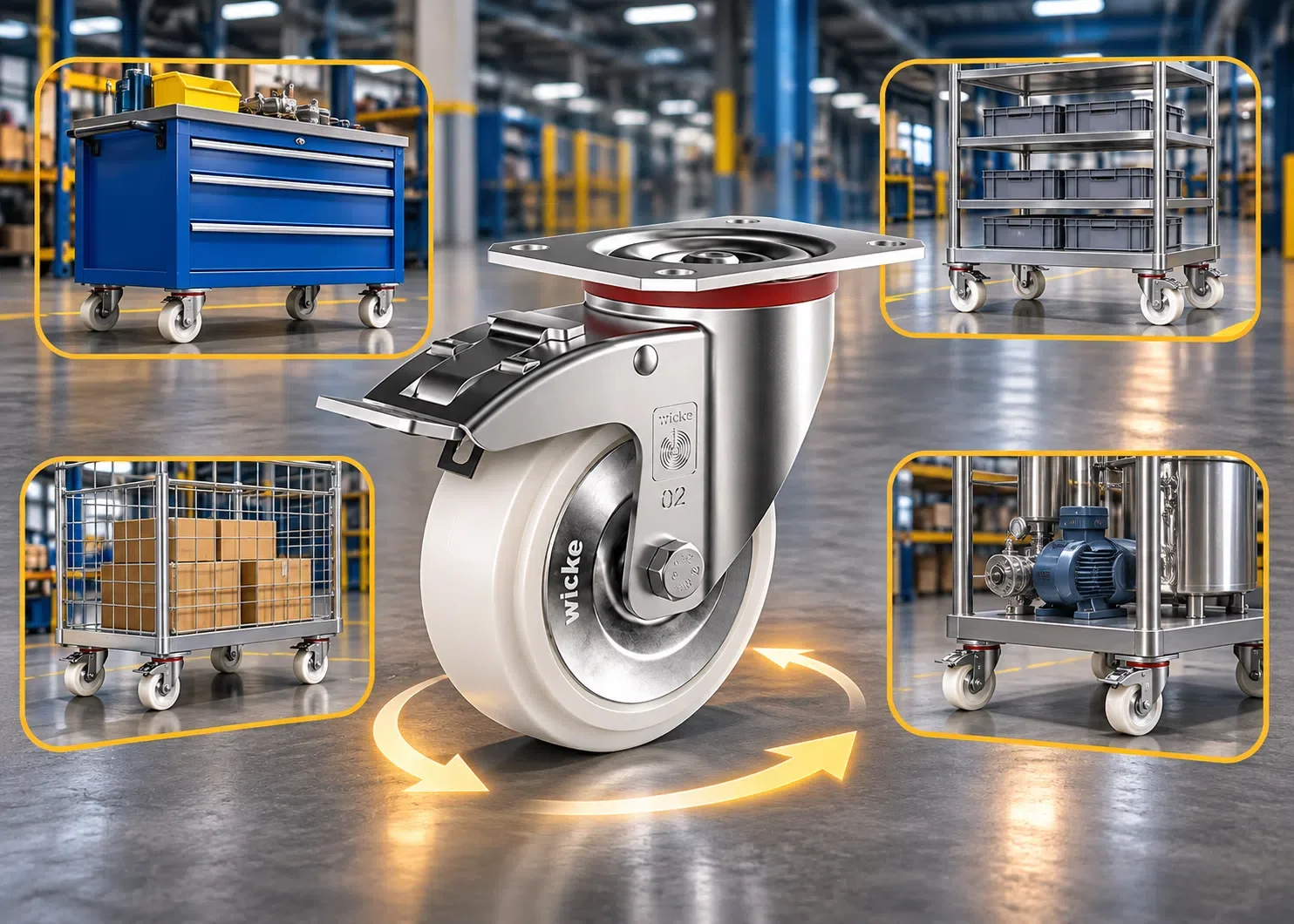
A swivel caster is a mechanical mobility unit equipped with a vertical axis that allows the wheel to rotate freely through a full 360 degrees. This grants equipment and handling carts superior agility, enabling instant turns and smooth maneuvering in any direction without the need to reposition the entire unit.
The secret behind this exceptional flexibility lies in the caster fork head, which contains a circular bearing assembly known as a "swivel bearing." High-efficiency swivel casters provide clear mechanical and operational value to facilities:
Ease of navigation in confined spaces: The ability to move containers and machinery through narrow logistics aisles and around sharp corners without requiring excessive pushing force.
Reduced physical strain on operators: Lowering the initial torque required to change direction, which directly contributes to reduced worker fatigue and fewer back injuries.
Compatibility with automated transport technologies: Supporting the movement of industrial robots and automated guided vehicles (AGVs) within advanced sorting centers, enabling them to execute complex paths with high precision.
Time savings in internal transport cycles: Accelerating deliveries between production departments and warehouses by eliminating the need for repetitive, cumbersome maneuvering.
Key Uses and Field Applications for Swivel Casters
The dynamic flexibility of these casters makes them an essential component in various operational sectors that require a high degree of maneuverability:
1. Assembly lines and precision equipment manufacturing
During the assembly of automobiles or electronic products, technicians often need to move components and rotate them around machinery with extreme smoothness to access various mounting points.
Using flexible swivel casters on mobile workbenches and tool stands allows them to pivot instantly around the technician—without the need for lifting or forceful dragging—thereby protecting sensitive electronic components from sudden vibrations that could cause damage. 2. Logistics Warehouses and Distribution Centers
The movement of goods within shipping facilities depends on the speed of loading and unloading between trucks and storage platforms. This is where precise mobility configurations play a crucial role:
Order-picking carts, which navigate through crowded aisles to retrieve products rapidly.
Mesh transport cages and roll containers, which move goods sequentially throughout distribution centers and require complete flexibility when being maneuvered or staged.
Platforms for rapid parcel handling in e-commerce warehouses, where high-intensity operations demand seamless flow to prevent any internal bottlenecks.
3. The Medical Sector and Pharmaceutical Manufacturing
Hospitals and cleanrooms require quiet, contamination-free environments. Equipment such as patient beds, emergency carts, and mobile X-ray units are equipped with quiet, antimicrobial swivel casters—ensuring minimal disturbance to patients while facilitating swift medical intervention in busy corridors and rooms.
How should caster placement be organized to achieve the ideal balance of movement?
Relying on swivel casters does not necessarily mean equipping every cart with four swiveling wheels. Instead, the configuration should be tailored to the specific operational purpose:
Two swivel casters at the front and two fixed casters at the rear: This is the most common and practical setup for manual transport carts, offering excellent stability on long, straight paths while allowing for easy steering around corners. Four fully swivel casters: The best choice for containers and worktables in extremely tight spaces, as they allow for complete lateral and transverse movement. However, they require greater focus to maintain a straight path over long distances.
Four swivel casters with a directional lock: An advanced engineering solution that allows the operator to lock the orientation of the rear casters—effectively turning them into fixed casters for straight-line travel—and then release the lock with a simple tap of the foot to restore full 360-degree swivel capability when entering narrow aisles.
Criteria for Selecting Swivel Casters for Heavy-Duty Environments
To ensure that a swivel caster functions for many years without bearing damage or loss of swiveling capability, several technical factors must be considered:
Swivel offset (or "lead"): The horizontal distance between the center of the caster’s swivel axis and the center of the wheel axle itself. When this offset is precisely calculated, the cart’s steering becomes smoother, and the occurrence of wobbling or violent vibration during movement is minimized.
Protection for swivel bearings: Equipping the caster head with tight-fitting dust seals and external lubrication points prevents debris, such as metal shavings or fibers, from entering the ball bearings. This prevents the mechanism from seizing or experiencing metal-on-metal friction.
Total lock systems: Braking only the wheel—without locking the swivel mechanism—can still allow the cart to drift slightly. Therefore, it is recommended to choose casters with a dual-locking brake—one that simultaneously locks both the wheel rotation and the swivel fork—to ensure complete and absolute immobilization.
Tread material suited to the flooring: Selecting flexible polyurethane or high-performance rubber ensures optimal traction with the floor, preventing unwanted lateral sliding during quick turns.
Frequently Asked Questions About Swivel Casters
What is the difference between swivel casters and fixed casters?