- By Admin
- Corporate
How do you choose the best industrial caster suppliers in the Middle East?
Supply chains in the Middle East face environmental and operational challenges that leave no room for haphazard solutions or mediocre products. From high temperatures and humidity levels within warehouses to the demanding nature of industrial environments—which require immediate responsiveness and a seamless flow of materials—there is no margin for error. Sourcing from an unqualified provider can trigger critical supply crises; for instance, inferior casters can lead to sudden equipment failure and operational downtime, ultimately costing a facility far more than any initial savings on the purchase price.
Partnering with a reliable supplier is not a luxury; it is a cornerstone of production continuity. Finding an operational partner who understands your facility’s specific requirements spares you from costly trial-and-error processes and frequent replacements that waste both time and budget.
What are the essential criteria for selecting a reliable supplier of industrial casters?
The best industrial caster suppliers in the Middle East are those that offer authentic products compliant with international standards. They provide precise technical consultation to help you select the appropriate load capacities and materials, maintain local inventory to ensure rapid delivery, and offer robust after-sales support and warranty services. Evaluating and selecting suppliers goes beyond merely comparing written price quotes; it requires an assessment of their operational capabilities and their ability to adapt to the demands of the regional market, based on several key pillars:
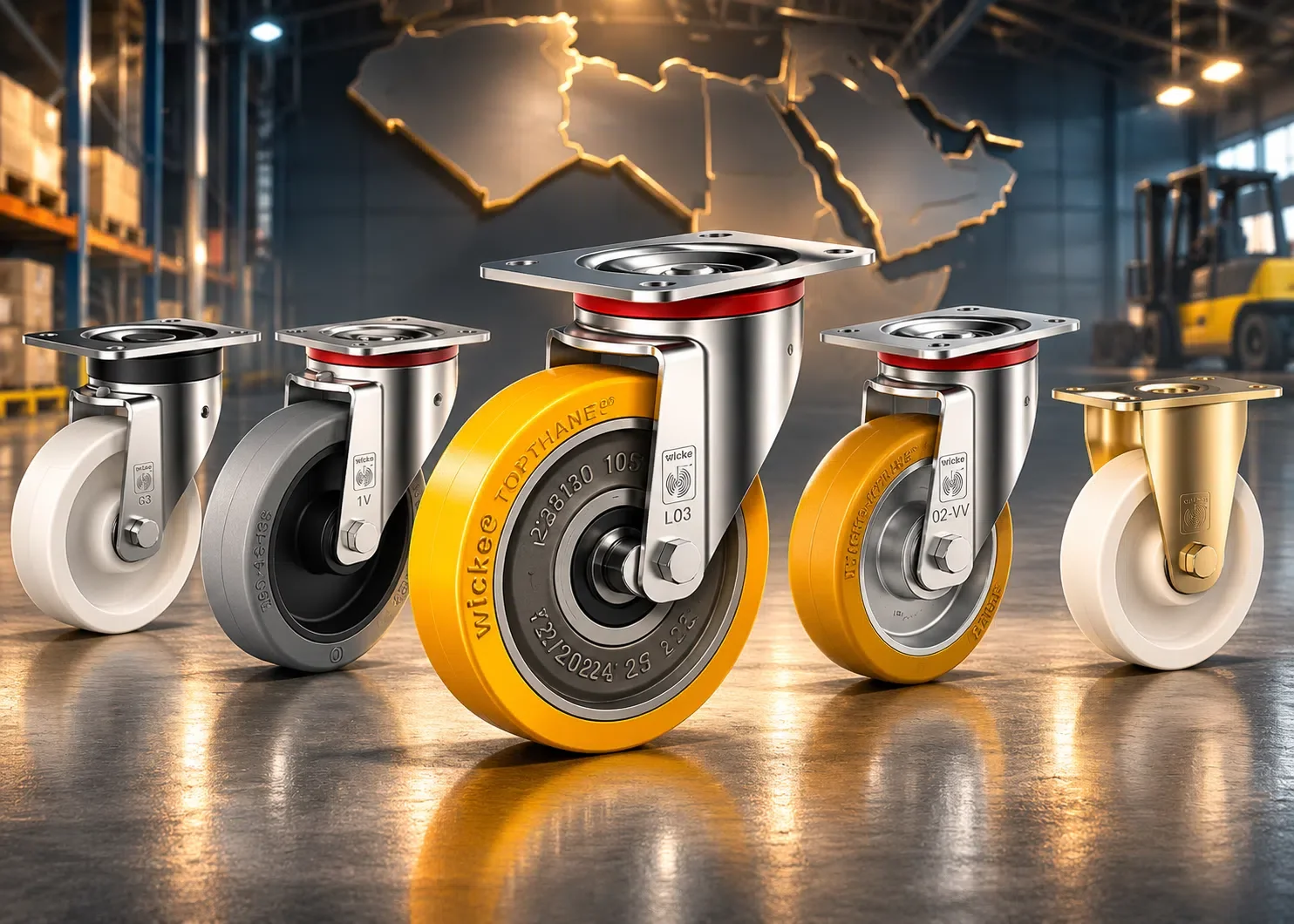
Product and Material Diversity: The ability to provide comprehensive solutions that cover all requirements—such as wear-resistant polyurethane, flexible rubber, and food-grade or chemical-resistant nylon—as well as cast-iron wheels designed for heavy-duty loads.
Readiness and Inventory Availability: Maintaining local warehouses capable of fulfilling immediate supply requests and providing spare parts, eliminating the need for long waits associated with international shipping.
Accreditations and Quality Certifications: Offering products that have undergone European or American quality testing, supported by documented technical datasheets that precisely specify the load-bearing capacity of each wheel.
Technical and Consultative Expertise: The supplier’s engineering team should be capable of assessing your facility, analyzing floor conditions and load requirements, and recommending the ideal model—rather than simply engaging in a basic, transactional sale.
How can you analyze a supplier’s expertise and efficiency before signing a supply contract?
Evaluating suppliers requires preliminary steps to protect you from intermediaries who lack specialized knowledge:
1. Engineering Consultation and Load Calculations
A professional supplier will not simply ask for the "wheel size." Instead, they will inquire about the method of movement—whether manual or mechanical (e.g., using warehouse tuggers)—the nature of the flooring (such as concrete or epoxy), and the daily temperature range. Providing a technical study—complete with a triple safety factor calculation and friction analysis—is what distinguishes a mere retailer from a mobility solutions expert committed to the safety of your assets.
2. Testing Samples in a Real-World Operational Environment
A supplier confident in the quality of their solutions will allow your plant engineers to test operational samples on your daily-use carts before you commit to large-scale orders. This enables the monitoring of key field performance indicators, such as:
The tread’s resistance to heat and oils, ensuring no cracking or separation from the metal core occurs.
Ease of rolling and maneuverability within narrow aisles, even under maximum design load.
The absence of any marks or dark carbon streaks on treated flooring surfaces.
Distinguishing a Certified Supplier from Non-Specialized Local Traders
Differentiating between authentic sources and unreliable importers protects you from purchasing counterfeit, short-lived products:
Trusted Brands: A certified supplier represents major, world-leading German or European manufacturers of industrial casters, maintaining direct and streamlined supply channels.
After-Sales Support and Accessories: They provide essential components—such as replacement bearings, specialized brakes, and swivel or fixed fork assemblies—allowing you to replace individual parts rather than being forced to discard and replace the entire unit.
Flexibility for Large-Scale Projects: They possess the logistical capacity to execute recurring, scheduled supply contracts, ensuring a seamless flow of components to your production lines and warehouses without any disruption to your supply chain. Practical Steps for Selecting the Ideal Industrial Caster Supplier for Your Factory
To streamline your procurement process and identify the best industrial caster suppliers in the Middle East, it is recommended to follow these steps:
Prepare a clear technical requirements document: Precisely specify the total equipment weight, flooring type, required speed, and operating environment (temperature, humidity, exposure to chemicals).
Request test and compliance certificates: Ask for quality and durability certifications—issued by the manufacturer—for every item proposed in the technical offer.
Review the supplier’s track record and experience: Examine the supplier’s past projects with major facilities in the region, such as pharmaceutical plants, automotive assembly plants, logistics warehouses, and ports.
Compare the Total Cost of Ownership (TCO): Evaluate the purchase price against the product's expected lifespan and maintenance requirements. A higher-priced caster that lasts four years offers far greater value than a cheaper alternative that needs replacement every six months.
Frequently Asked Questions About Industrial Caster Suppliers
How can I ensure that a supplier provides genuine, non-counterfeit casters?
You can verify this by requesting official technical data sheets, checking for brand marks or stamps engraved directly onto the metal or the caster tread, and asking for authenticated certificates of origin.
Can the supplier provide specifications customized for the Middle East’s climate? Yes, professional suppliers offer products made from polyurethane or heat-treated rubber. These are equipped with sealed bearings packed with synthetic grease capable of withstanding temperatures up to 300°C, while also providing resistance to dust and high humidity.
What is the minimum acceptable warranty for industrial casters?
The warranty depends on the nature of the usage and the type of facility; however, a reliable supplier typically provides a one-year warranty against manufacturing defects and tread separation, provided that the specified load limits are respected and the equipment is used correctly.
Identifying the best suppliers for industrial casters is a strategic investment that ensures the stability of transport lines and the smooth operation of processes within your facility. Focusing on...