- By Admin
- 21 Sep, 2026
- Corporate
Grey rubber tires to facilitate movement in enclosed warehouses
Indoor warehouses and storage centers require mobility solutions that make it easier to move products and materials between aisles, preparation areas, and shipping zones. With the frequent use of carts and manual handling equipment, wheels become an important component that directly affects handling efficiency and noise levels during operation.
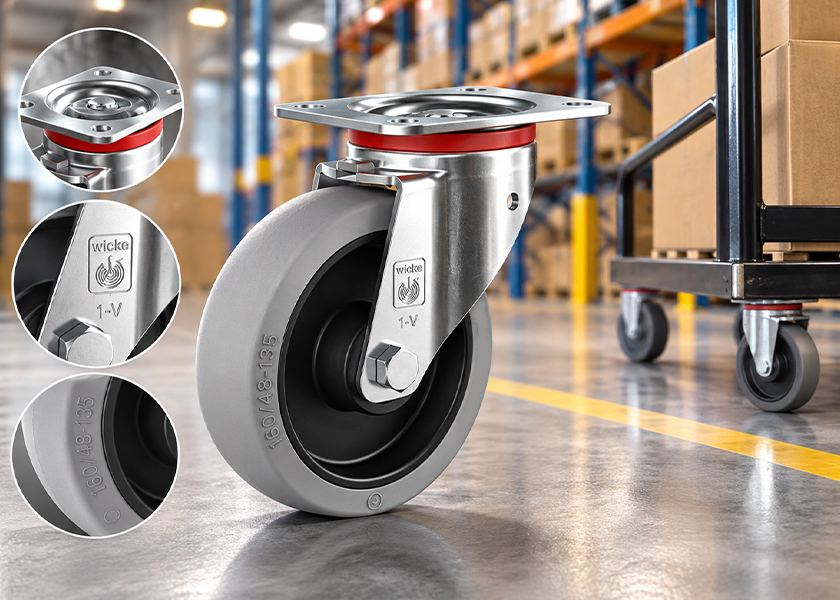
Gray elastic rubber wheels are used in various internal transport applications, combining flexibility, reduced noise, and floor protection in certain designs. Some gray WICKE-ELASTIC series offer different load capacities, with models designed for manually moved equipment.
Therefore, when searching for quiet-running wheels in Saudi Arabia, it is important to understand the application and choose the wheel material, diameter, and load capacity according to the warehouse operating conditions.
Why Use Gray Rubber Wheels in Indoor Warehouses?
Indoor warehouses differ from outdoor operating environments. Movement usually takes place on industrial floors, through defined aisles, and repeatedly throughout the day.
Elastic wheels can be suitable for applications where the following are important:
- Reduced noise during movement.
- Greater comfort when pushing carts.
- Better protection for suitable floor surfaces.
- Good shock absorption.
- Easy maneuverability through aisles.
WICKE describes its Wicke-ELASTIC wheels as designed for comfortable, low-noise operation, with some models featuring non-marking properties for applications where minimizing floor marks is important.
What Are Gray Elastic Rubber Wheels?
Some gray WN wheels from WICKE feature a polyamide wheel center with a gray Wicke-ELASTIC rubber tread with a hardness of 63 Shore A and are available with roller bearings.
Certain models are available with different load capacities depending on their dimensions and design. For example, WICKE's WE series includes gray non-marking elastic rubber wheels with ball bearings, while the product range offers load capacities that vary by model.
The exact load capacity should always be verified using the technical specifications of the specific wheel before use.
Quiet-Running Wheels in Saudi Arabia for Warehouses
Noise levels become increasingly important in indoor warehouses when large numbers of employees are working in the same area.
The repeated movement of dozens of carts throughout the day can create unwanted noise, especially when hard-surface wheels are used on hard floors.
Some elastic rubber wheels are designed to reduce operating noise and absorb part of the impact, making them suitable for internal transport applications where noise levels are an important consideration. WICKE's Wicke-ELASTIC range is described as offering low-noise running, low rolling resistance, and good floor protection.
Using Indoor Warehouse Wheels in Saudi Arabia
Indoor warehouse wheels in Saudi Arabia can be used in a variety of applications, including:
Storage Carts
They can be used to move products from storage locations to preparation areas.
Order Picking Carts
They help move products and packages between storage racks and packing areas.
Tool Carts
They can be used on carts transporting maintenance tools and equipment throughout the facility.
Service Carts
They are suitable for indoor service carts where relatively quiet movement is required.
How Do You Choose the Right Wheel for a Warehouse?
Floor Type
The floor is the first factor that should be considered.
Elastic wheels can be suitable for hard floors when reduced noise and shock absorption are important, but the wheel material must be compatible with the specific surface.
Load Capacity
Calculate the weight of the cart and the load it will carry.
Do not consider only ideal operating conditions. Actual operating conditions and potential impacts during movement should also be taken into account.
Wheel Diameter
A larger wheel diameter can help some applications move over floor joints and small obstacles more easily. However, the final choice depends on the cart design and available space.
Bearing Type
Some wheels are available with roller bearings, and the bearing type can affect rolling resistance and overall wheel performance.
Gray or Black: Which Is Better?
The better option cannot be determined by color alone.
The real difference depends on the rubber compound, wheel construction, and product specifications.
For example, WICKE offers Wicke-ELASTIC wheels in both gray and black across different series, with variations in load capacities, designs, and applications. Some gray models also feature non-marking properties.
Therefore, the product should be selected according to its specifications rather than its color.
When Do You Need Swivel Wheels?
If the cart needs to change direction within warehouse aisles, swivel wheels can make maneuvering easier.
For straight-line movement, fixed wheels may be more suitable.
Many carts use a combination of swivel and fixed wheels to achieve a balance between maneuverability and stability.
The Importance of Choosing the Right Wheel for Indoor Warehouses
The right wheel affects more than just cart movement. It can also influence employee comfort, floor condition, and the efficiency of material handling operations.
For this reason, the wheel should be considered as part of the overall internal transport system.
Industrial wheels are used across logistics, warehouse, and internal transport applications, with different materials selected according to floor conditions, load requirements, and operating environments.
Choosing Quiet-Running Wheels in Saudi Arabia
When equipping warehouses, wheels should be compared based on several factors:
- Noise level.
- Load capacity.
- Wheel diameter.
- Wheel width.
- Rubber material.
- Bearing type.
- Floor type.
- Operating hours.
- Movement requirements.
One Step provides industrial wheels and caster solutions for warehouses, storage facilities, and material handling applications.
Conclusion
Quiet-running wheels in Saudi Arabia made from gray elastic rubber can help improve the internal transport experience in warehouses when selected according to floor conditions, load capacity, and operating requirements.
The choice should not be based on color alone. The rubber compound, wheel diameter, load capacity, bearing type, and mounting configuration should all be considered to ensure the wheel is suitable for the application.
Frequently Asked Questions
Are gray rubber wheels suitable for indoor warehouses?
Yes. Gray elastic rubber wheels are available in designs intended for indoor transport and warehouse applications.
Are gray wheels quieter?
Some elastic rubber wheels are designed to reduce operating noise, but actual noise levels depend on the wheel design, floor surface, and operating conditions.
Are gray rubber wheels non-marking?
Some gray products are specifically designed with non-marking properties, but the specifications of the individual product should always be checked.
What is the best wheel diameter for a warehouse?
There is no single diameter that is suitable for every application. The choice depends on load capacity, floor conditions, cart design, and movement requirements.