- By Admin
- Corporate
A Comprehensive Guide to Selecting Industrial Casters for Your Factory’s Needs
Choosing the right mobility system for manufacturing and logistics environments is more than just a routine procurement of consumable spare parts; it is a strategic engineering and investment decision. It directly impacts the fluidity of production lines, the safety of personnel, and long-term operational maintenance costs. A small caster supporting a heavy-duty transport cart is subjected to immense mechanical stress, as well as chemical and thermal friction. Any mismatch between the caster and the flooring type or load pattern can immediately lead to unexpected production line stoppages, damage to flooring, or costly workplace accidents.
Providing effective internal transport solutions requires a deep understanding of the operating environment. If you are looking for a long-lasting investment, you should not merely seek a wheel that spins; rather, you need a mobility solution precisely engineered to address the specific conditions of your facility.
What are industrial casters, and why are they important for production lines?
Industrial casters are heavy-duty mechanical rotating units attached to the underside of equipment, containers, and handling carts. They facilitate the efficient movement of heavy loads, reduce rolling resistance, and protect flooring from wear and tear, all while minimizing the physical effort required for manual or automated transport.
When examining operational workflows within modern industrial facilities, it becomes clear that every step—from moving raw materials to transporting finished products—relies entirely on the efficiency of these rotating components. Investing in high-quality industrial casters offers critical operational advantages:
Reducing physical strain on workers by lowering the force required to initiate and maintain movement, thereby helping to prevent workplace injuries and musculoskeletal disorders.
Protecting industrial flooring, preventing cracks and deep scratches in expensive concrete or epoxy surfaces.
Lowering periodic maintenance costs and avoiding frequent replacements or bearing wear caused by poor product selection.
Absorbing shocks and vibrations to safeguard sensitive products and precision components during internal transport.
Key Factors for Selecting the Right Casters
Choosing casters without proper analysis quickly leads to mechanical failure. To select the appropriate type, operational variables must be evaluated with engineering precision:
1. Calculating Total Load and Applying the "Three-Wheel" Safety Rule
A common mistake in industrial settings is calculating the load by simply dividing the total weight equally among four casters. In reality, factory floors are rarely perfectly level; consequently, often only three casters bear the entire weight when moving over floor joints or minor obstacles.
The correct calculation: The required load capacity per caster is the weight of the empty cart plus the maximum expected load, divided by 3.
Adding a safety margin of 20% to 33% ensures the equipment can withstand sudden loads and impacts resulting from rough handling. 2. Floor Surface and Path Conditions
The golden rule for movement is quite simple: for hard floors, choose soft wheels; for soft floors, choose hard wheels.
Smooth, delicate surfaces—such as epoxy or tile—require wheels with a soft, flexible tread. This prevents scratching and ensures no dark marks are left behind during maneuvering or sudden braking.
Rough or cracked floors require a larger wheel diameter and a thick rubber tread, which absorbs shocks and allows the wheel to navigate obstacles without violent jolts.
Floors exposed to oils or chemical liquids require materials that are resistant to acids and oils, preventing the tread from deteriorating prematurely.
Industrial Wheel Materials and Their Applications
The material of the outer tire determines the wheel’s overall performance and its lifespan under constant mechanical stress:
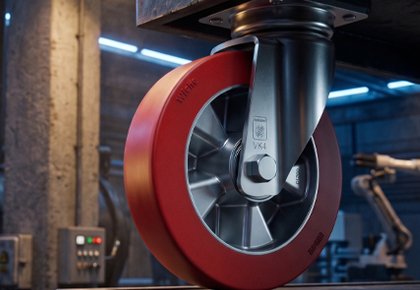
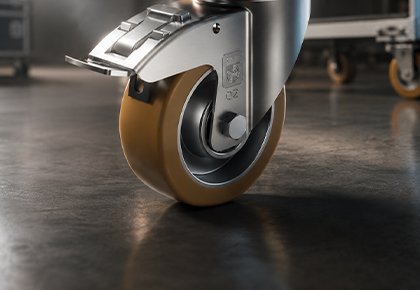
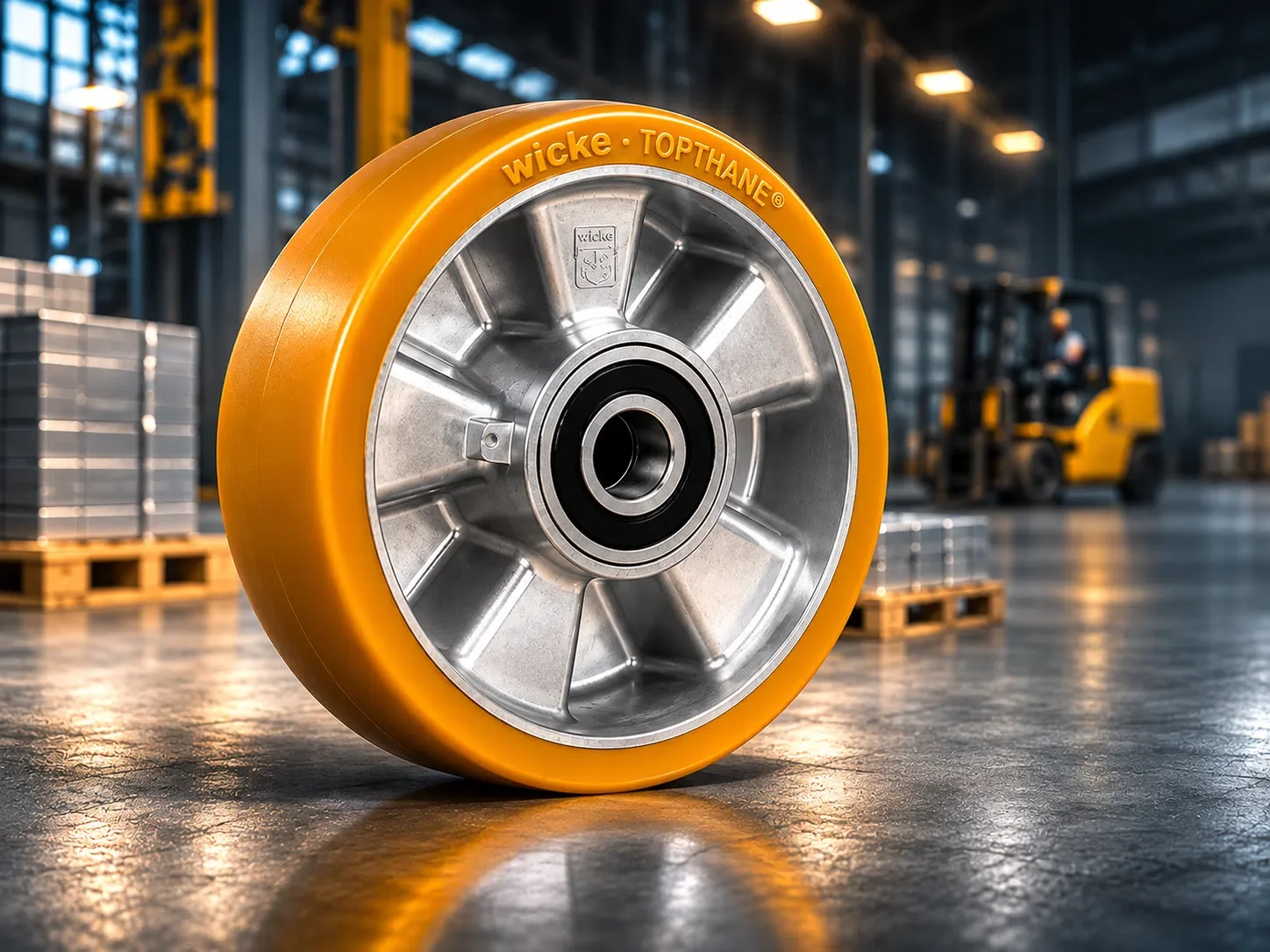
Polyurethane: Offers superior load-bearing capacity and high resistance to cuts and oils, while providing excellent protection for delicate floors. It is the preferred choice for pharmaceutical plants, automotive assembly facilities, and modern logistics warehouses.
Solid Rubber: Provides exceptional vibration absorption, ensuring quiet, smooth, and flexible movement. It is a cost-effective solution for workshops, medium-duty conveyor lines, and hospitals.
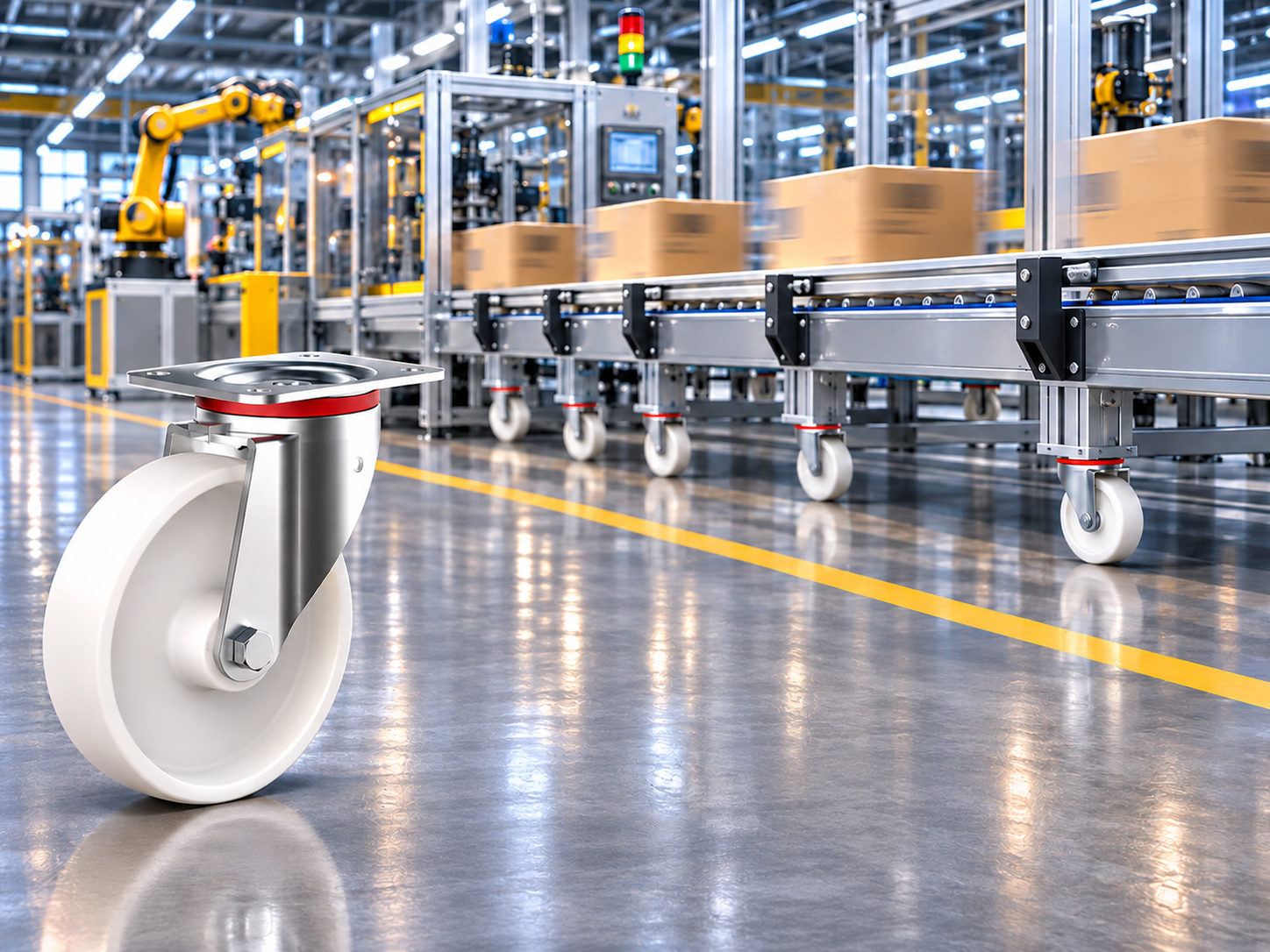
Nylon (Polyamide): Features excellent chemical resistance and facilitates easy movement under heavy loads. It is also highly washable and easy to sanitize, making it ideal for the food industry, cold storage facilities, and chemical plants. Cast Iron and Steel: These materials offer superior durability, ensuring they do not break under extremely heavy loads. They also provide exceptional resistance to high temperatures, making them ideal for use in foundries, cement plants, and heat-treatment furnaces.
Types of Mounts and Mounting Options
An industrial caster does not function in isolation; it is part of a complete assembly known as a fork or mount:
Rigid (Fixed) Caster: Moves only in a straight line, providing a precise, stable path that resists drifting over long distances.
Swivel Caster: Rotates 360 degrees, thanks to dual-bearing assemblies in the head, offering excellent maneuverability in narrow aisles and around sharp turns.
Total Lock Caster (with Dual Brakes): Simultaneously locks both the wheel’s rotation and the swivel movement of the mount. This is a mandatory safety feature for use on inclines or when securing equipment during operation.
The most effective, classic configuration for hand carts involves installing two rigid casters at the rear and two swivel casters with brakes at the front. This setup achieves an optimal balance between directional stability and ease of control during loading and unloading.
How to Maintain Caster Efficiency and Prevent Premature Damage
Simple neglect can reduce a caster’s operational lifespan by as much as 75%, leading to unnecessary annual replacement costs. A straightforward preventive maintenance program can help you avoid these losses:
Remove obstructions—such as threads, strings, or plastic straps—from the swivel assembly on a weekly basis; these can wrap around the axle and impede the rotation of the bearings. Use lubricants suitable for the operating temperatures—especially for casters used in foundries or frozen food processing plants.
Check the alignment of the forks and ensure there is no distortion in the caster bracket resulting from the cart colliding with the tines of a forklift.
Prevent indiscriminate overloading and train warehouse operators not to exceed the [specified] load limits.